---
include_toc: true
gitea: none
---
jj-cz: Conventional Commits for Jujutsu
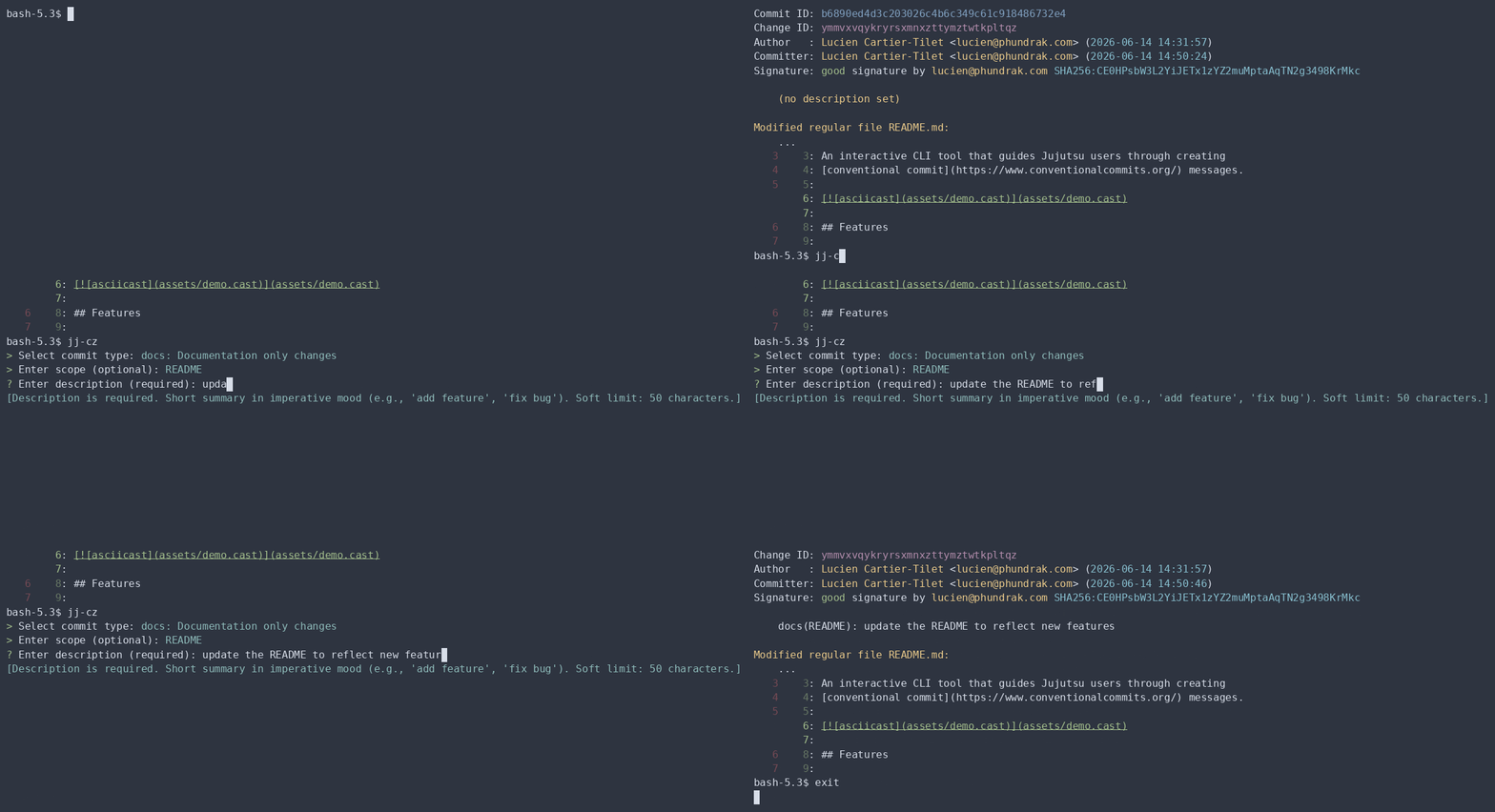
An interactive CLI tool that guides Jujutsu users through creating conventional commit messages.
[](assets/demo.cast)
## Features
- Interactive prompts for type, scope, breaking changes, ticket references, and description
- All 11 commit types with descriptions (feat, fix, docs, style, refactor, perf, test, build, ci, chore, revert)
- Optional scope with validation
- 72-character first-line limit enforcement
- Preview before applying
- Clean cancellation with Ctrl+C
## Usage
No fancy tricks, just run `jj-cz`.
```sh
jj-cz
```
The tool detects whether you're in a Jujutsu repository, guides you
through the commit message, and applies it to your current change.
You can also set the revision message of a few revisions at once, or
target a single revision other than the current one.
```sh
jj-cz @- xs develop # assuming the revision xs and the bookmark develop exist
```
No explicit revision is simply the equivalent of `jj-cz @`, like
`jj desc`.
If you want to create a new revision after calling `jj-cz` on a single
revision, you can use the `-n` or `--new` flag.
```sh
jj-cz -n # equivalent of `jj-cz && jj new`
jj-cz xs -n # equivalent of `jj-cz xs && jj new`
jj-cz -n xs # equivalent of `jj-cz xs && jj new`
```
You cannot, however, call `jj-cz` on multiple revisions with the `--new` flag active.
## Requirements
- A Jujutsu repository
- An interactive terminal
You don’t need `jj` itself to be installed at all, though I’m not sure
what `jj-cz` alone would be good for without `jj`.
## Exit Codes
| Code | Meaning |
|------|------------------------------------------------------|
| 0 | Success or clean cancellation |
| 1 | Error (invalid input, repository issues, jj failure) |
| 130 | Interrupted |
## Installation
### From crates.io
Simply run the following command:
```
cargo install jj-cz
```
Done! `jj-cz` is now available!
### With Nix Flakes
Notice how there’s a `flake.nix` file? This means you can run the
project using this repository as one of your flakes inputs. In fact,
that’s how I install it in my own NixOS configuration! Add this
repository to your configuration:
```nix
{
inputs = {
nixpkgs.url = "github:nixos/nixpkgs?ref=nixos-unstable";
jj-cz = {
url = "git+https://labs.phundrak.com/phundrak/jj-cz";
inputs.nixpkgs.follows = "nixpkgs";
};
};
}
```
And tadah! you can now install
`inputs.jj-cz.packages.${pkgs.stdenv.hostPlatform.system}.default`
among your other packages. Take a look at my
[`jujutsu.nix`](https://labs.phundrak.com/phundrak/nix-config/src/branch/main/users/modules/dev/vcs/jujutsu.nix)
module if you need some inspiration.
### From source
You can also install `jj-cz` with Cargo by building it from source.
Just make sure Rust is available on your machine (duh!).
```sh
cargo install --path .
```
## Tips and questions
### Running `jj cz` instead of `jj-cz`
I do not actually use `jj-cz`, but `jj cz`. I just find it more
natural to treat it as its own jj subcommand. To achieve that, you can
simply add an alias to your jujutsu configuration.
```toml
[aliases]
cz = ["utils", "exec", "--", "jj-cz"]
```
### `$EDITOR` and editing the revision’s body message
`jj-cz` relies on your `$EDITOR` variable to open a temporary file in
which you’ll write the body of your commit. This body does not include
some footers `jj-cz` may include by itself, such as the breaking
change footer.
In some cases, you may not notice a new editor open. In this case,
check whether you already have an editor open, the file might be
there. In my case, if I already have an open Emacsclient, it will open
there.
## License
This project is licensed under either the [MIT](LICENSE.MIT.md) or [GPL-3.0](LICENSE.GPL.md) licenses, as you prefer.




